Dogs make a difference in so many areas of our lives, and nowhere is that more apparent than in the incredible ways that service dogs are able to help their handlers. Service dogs are an invaluable asset to individuals with disabilities, helping them to improve their quality of life.
Within the legislation that defines a service dog (the Americans with Disabilities Act, also known as the ADA), there is nothing that says a service dog needs certification or is required to be trained by a professional dog trainer. It is possible for service dogs to be fully-trained by their handler, as long as the service dog fulfills the criteria set out in the legislation.
Where this part of the process can be problematic is when a handler has a pet dog that they want to train for service dog work – but the dog is clearly not an appropriate candidate for the job. Someone who is not a professional dog trainer is not going to be adept and experienced enough to train what I would consider a legitimate service dog.
Training service dogs is serious business for people who have a serious need for a service dog to perform a particular task or tasks. The industry of service dogs is rife with fraudulent trainers looking for a money grab, and the service dog industry is fraught with many fake service dogs that are out there wearing service dog vests (not required by the ADA) ordered from Amazon. There are service dogs out there that simply don’t have the ingredients to be a service dog in terms of temperament, and don’t have the elite level of exemplary obedience required to be a service dog.
These fake service dogs are easily spotted by experienced trainers. For a service dog team to succeed, it requires a dog with specific traits and temperament. Lately, there have been many examples of dog owners seeking trainers to train their dog for service dog work for completely the wrong reasons. Those reasons include being able to take their dog anywhere (such as flying with their dog) because of their emotional attachment to the dog. An emotional support animal and a service dog are two very different things. What happens when an illegitimate service dog displays bad behavior from incompetent training that would be unbecoming of a legitimate service dog? The standards and practices completely degrade the industry as a whole; it unfairly tarnishes the reputation of devoted service dog trainers, hard-working service dogs, and ultimately, folks with real hardships where the dog is essential to their quality of life.
In this article, we’re going to look at why not every dog is a good candidate for service dog work – and what is desirable when identifying a suitable partner for a service dog team.
What do service dogs do?
There are a lot of misconceptions about service dogs, and they are often conflated with the work of emotional support animals (ESAs) and therapy dogs. While ESAs and therapy dogs provide valuable emotional assistance to their handlers, service dogs perform a very specific role that is protected by the ADA.
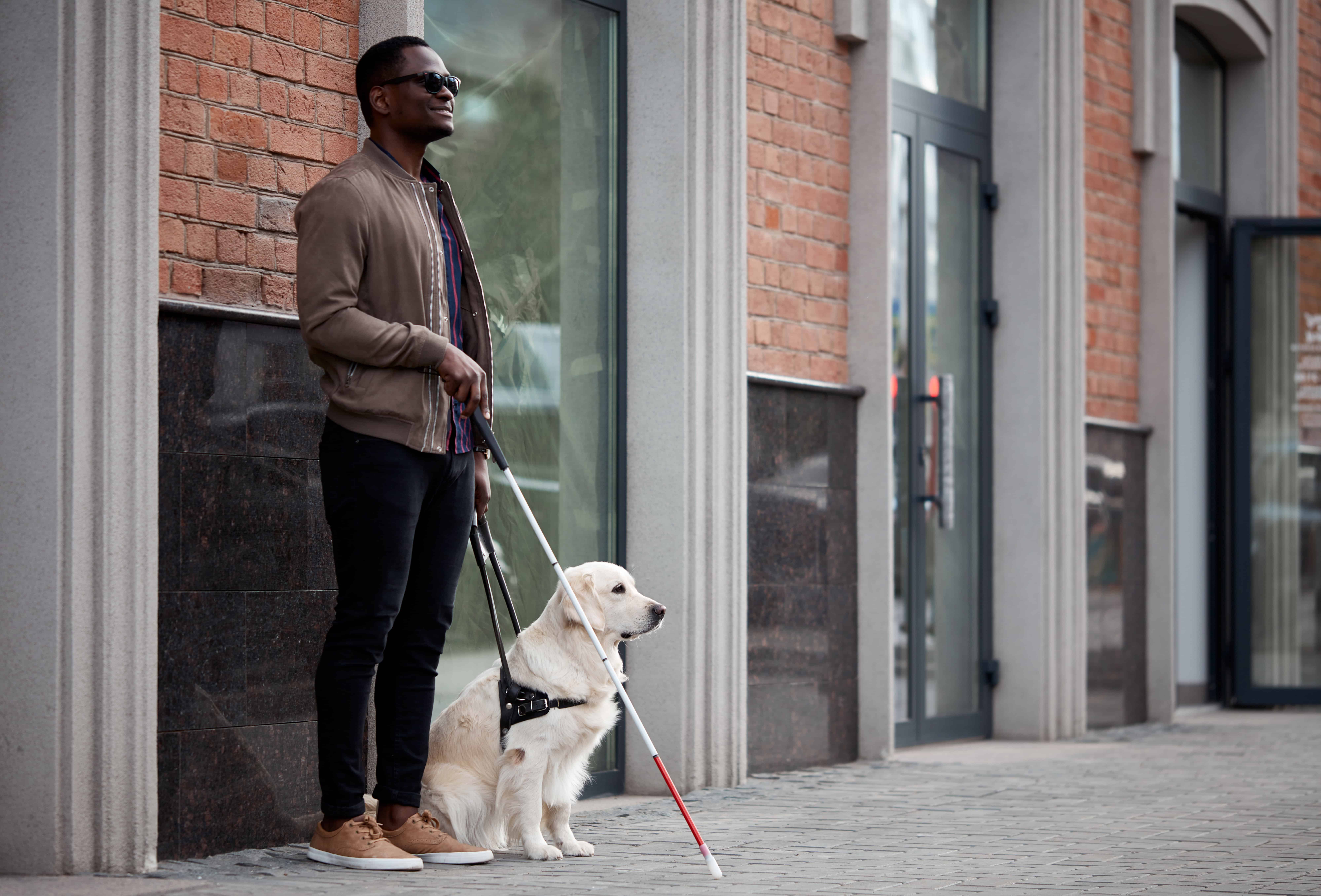

Service dogs are trained to perform tasks that help a handler with a physical or mental disability. For example, a mobility service dog may help an older person to move around their home. A guide dog may help a visually impaired individual to navigate around the world safely. Due to the value they provide to their handlers, service dogs are often able to access public areas (such as restaurants, grocery stores, airplanes, doctor’s offices, and so on) that would be otherwise out-of-bounds for dogs. As part of their role, service dogs must be under the control of their handler at all times and be housebroken.
The provisions within the ADA allow for business owners and staff to ask limited questions of a service dog handler – is the dog a service animal required because of a disability, and what work or task has the dog been trained to perform. The business cannot ask to see ‘papers’ or certification demonstrating that the dog is a service dog, nor can they demand that the service dog perform its tasks. A business cannot discriminate against an individual with a service dog by treating them less favorably than other customers; this is protected by the federal government.
Core traits required for service dog work
Due to the very public nature of their work, service dogs must have an exemplary temperament and calm disposition. In fact, while a successful service dog must be able to understand and perform tasks when appropriate, perhaps the most important factors when selecting a service dog candidate occur before any task training takes place. Selecting a dog with the right temperament for service dog work is vital.
Here are some of the traits that make a successful service dog:
- Emotionally stable – Remains calm in all situations.
- Social tolerance – Comfortable around strangers (and animals).
- Focus and trainability – Can understand complex tasks and retains information, even when distracted.
- Has the right motivation to work – Enjoys working but is not so high-energy or driven that it affects their ability to work.
- Low fear, high-coping threshold – Doesn’t typically shut down or overreact.
- Physical health – The dog has stamina and is an appropriate size for the job (ex: choosing a medium/large-size breed for mobility assistance).
Common reasons why dogs may not be suitable service dogs
Now that we know the core traits that dogs should display for service dog work, what are some of the common reasons why dogs may not be a good fit? This list is not exhaustive, but traits that may preclude a dog from being a successful service dog include:
- Reactivity
- Over-threshold responses
- Easily distracted
- Unable to focus
- Stress and/or anxiety in new places or around new people
- Resource guarding
- Medical issues
- Breed-typical traits that conflict with service dog work
The unfortunate reality is that we sometimes have a blind spot with our own dogs. Occasionally, when embarking on a new activity with our dogs, we sometimes gloss over or ignore the potential pitfalls in favor of focusing on the positives. When it comes to service dog work, the consequences are too important (for the handler, and for the community as a whole) for a misjudgment on whether a dog is a suitable service dog or not.
There also needs to be realistic expectations for any dog that embarks on service dog work. A high-drive, high-energy dog will often not have the discernment to safely perform the tasks in a high-distraction environment. This isn’t so much about trainability (many high-drive dogs are typically very trainable) as much as whether the dog has the right core temperament for service dog work. Training can help shape responses, but it cannot alter genetics or hereditary behaviors.
If you want to train your own service dog, what should you do?
I would dissuade someone from training their own service dog if they have not seen how service dogs are trained by professional service dog trainers. To use another example – I could probably do some plumbing in my home by myself, but I don’t know what I don’t know; particularly if I run into issues or unexpected situations.
Service dog training is a serious business, and I think that it is important to see what the standards are by people who have been doing it for a long time. If you can shadow a company who specializes in service dogs to see the reality of the process, this is important. Get with a trainer who has experience training service dogs. If you’re thinking about doing it yourself, consider this. You should already excel at teaching bombproof basic obedience to dogs before you even think about training a dog to be a service dog.
I personally think it’s not enough to have trained five or six family dogs to be very good at training service dogs. The dog should be able to pass a CGC test with flying colors after an obedience program. For a start, have a professional trainer get that brick house, solid foundation of basic obedience, which is an absolute requirement for any service dog. Then, maybe train the dog to do the specific tasks needed with the help of a trainer. If you have the time, capability, devotion and commitment to do so, then with the correct candidate, the bond that is created within the service dog training process can be beneficial for handler and service dog alike.
In phone consultations, I often hear people say, “I know my dog would make a great service dog.” I think it’s a beautiful thing for people to believe in their dog, or be excited about their dog’s potential. I always ask in response – how many real deal service dogs have you been around? Have you ever hung out with somebody who has a legitimate service dog for an entire day? It is wonderful to be aspirational about what your dog may have the potential to do. It’s also important to be realistic. You’re not going to know the puppy’s potential until they get close to six months old. You have to come to learn what your dog is good at first. A good analogy is parents who want their kid to be a doctor, but come to find out that they don’t have the aptitude for that but become a renowned musician instead. Or the parents who want their kid to play in the NBA but their kid is not close to tall enough, and comes to find out they’re an amazing tennis player instead.
What I would certainly recommend is that you get an impartial and unbiased evaluation from a professional dog trainer who can observe the dog’s behavior and temperament, and offer a realistic assessment on the dog’s suitability for the work. (I think this is actually a great idea for any new activity with your dog, whether that’s working disciplines like Search and Rescue or Mondioring, or temperament-based work like therapy dogs or service dogs.)
It is best to get an evaluation at the beginning of the process, to save putting copious amounts of time, money and energy towards a training process that may always be destined to fail because the dog doesn’t have the underlying traits to succeed. This is particularly important in service dog work, because as we said above, the risks are too big for a poorly-suited dog to be responsible for performing what can, sometimes, be life-saving tasks.
In conclusion
As a dog trainer, I am inundated with hundreds of calls saying I want my dog to be a service dog. When some of these folks tell me about their dog they describe behaviors that are disqualifying right out the gate to be a candidate. Many folks describe just needing an emotional support dog, but wanting ADA protections to enjoy the federally protected rights that legitimate service dogs require.
Out of all the calls I receive on this topic, in at least half of the cases, the owner doesn’t have an idea on the specific task in mind that they would need the dog to perform. My thoughts are that if one has a serious disability, you would know immediately the task that would help your quality of life. Loved ones or parents would know exactly what they need for their child with a disability. That is not to say that people don’t deal with real hardships or a diagnosis that makes life difficult (like depression and anxiety). But there is a difference between an emotional support animal and a service dog. What people don’t understand is that most service dogs are selected at anywhere from 8-14 weeks and start training right away, staying with the trainer or a professional service dog firm for up to at least six months. Even at the other end of that, many dogs get washed because they don’t make the cut to be a service dog. At K9 Evolutions Dog Training, we don’t actually offer service dog training as a service in itself – but we can evaluate your dog’s suitability for service dog work. In addition, we can help you get outstanding basic obedience and be able to pass a CGC which is a requirement for your dog to even be considered for Service Dog work. Reach out to us at info@k9evolutionsdogtraining.com or call (612) 227-7019 for more information.