
Have you ever noticed how your dog’s behavior changes in different places or around different people? Your dog is not unique in this phenomenon – in fact, it is a common occurrence with many dogs. The reason behind this is a simple one. Dogs are contextual learners, meaning that what they learn in one set of circumstances is not automatically transferred to a different situation.
The key to building this well-rounded behavior in a number of different scenarios is called Generalization. This means that your dog is able to behave as anticipated no matter when or where they are. As part of generalization, you can introduce distractions to enhance your dog’s training and make their behaviors increasingly robust, no matter what is going on around them.
In this article, we’ll look at why distractions are important; when to introduce them; and different types of distractions you can incorporate into your dog’s training.
Why distractions matter
Training around distractions is important for one clear reason – unless you keep your dog cooped up in the confines of their own home forever, distractions are what your dog will encounter when they experience the real-world. If you do not train your dog around distractions, you are not generalizing their behavior or setting them up for success. Working around distractions is something that can build not only your dog’s confidence in different situations, but your own peace of mind in your dog’s behavior.
When to introduce distractions
While training around distractions is part of the overall training plan for your dog, it is something that should be done systematically – and typically, only once your dog has been able to master commands in less-demanding settings (such as at home or the regular training grounds).
Far too often, people introduce distractions and outings way too soon. That would be like playing a piece of music in front of a busy crowd of people who paid money when you haven’t completed a single rehearsal. In the four phases of a dog’s learning, your dog should be long past the Acquisition Phase and at the end of the Fluency Phase. Think of it this way – before you build a house, you need a concrete foundation, or the house sits on shaky ground. I want the dog to have a strong anchor in all stationary positions and have confidence in the other elements of basic obedience so when the going gets weird, they can anchor in with confidence when something weird happens in their environment.
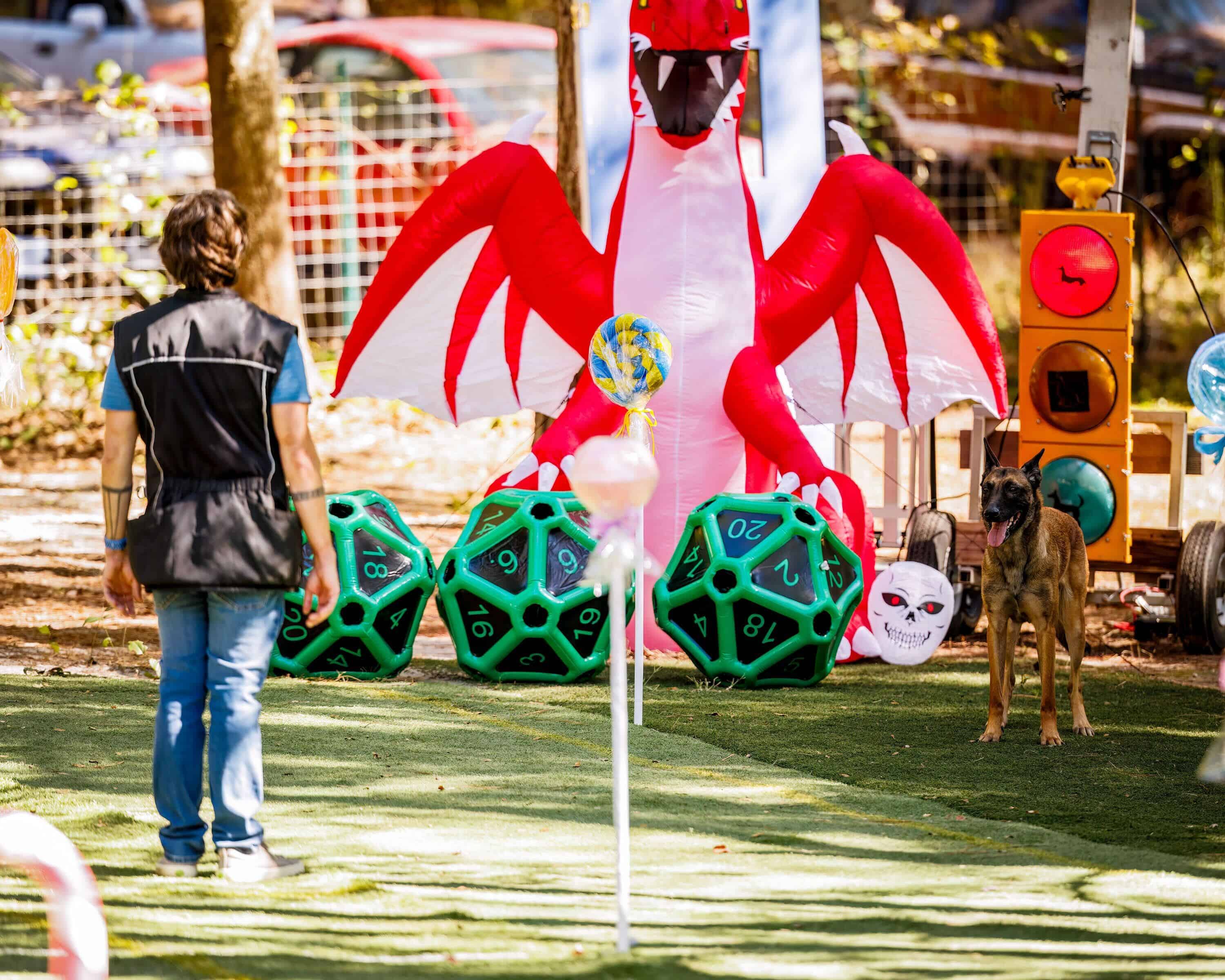
Distractions should be phased in slowly, in the environment where the dog is used to training first. Something simple as having your dog in a down-stay and going from slowly walking and orbiting them to jogging around them or doing jumping jacks while they’re in an implied stay. Think of it like turning a valve of intensity in distractions. It could be dropping a small bucket and seeing how they deal with that, or repeatedly opening an umbrella with closer and closer proximity. This is all done smartly so that if your dog freaks out with a particular distraction, you can widen the proximity of where their threshold is and slowly build their confidence with it. Some dogs could care less about an umbrella but freak out when they see a rolling garbage bin. With all of this in mind, it is best until you reach a point in your dog’s training where they are ready to work around distractions, otherwise you are simply setting them up for failure.
Types of distractions
We can categorize virtually all distractions into the following categories.
- Environmentals – When we think about distractions, this is probably the most common type. This is where the context around your dog changes to something completely novel – so it could be a new place; a change in weather; an escalator in a store; bicyclists at a park with bike paths; a new person. It could also be staying focused on you when around a new dog or at a place with lots of horses.
- Motion – When objects move, they can be a huge distraction for your dog as it pulls their focus away from you. These objects can be as large as a passing vehicle, or as small as a squirrel or leaves blowing in your backyard. It could be a kid on a skateboard, someone in a wheelchair, or two people playing frisbee. These distractions can be particularly hard to work around as it can activate your dog’s inherent prey drive.
- Auditory – Sudden loud noises. This could be construction noises; sirens; a crying baby, a barking dog; or a waiter or waitress dropping a tray of dishes at an outdoor eatery.
- Olfactory (smells) – Unfamiliar odors, scent markings from other dogs, food smells and trash, or the scent profiles of wildlife that are in the area.
- Visual – Flashing lights, the movement & body language of someone with a disability or the body language of a rambunctious child, reflections or shadows or even something specific like the sight of a clown making balloon animals at a kid’s birthday party.
- Social – Crowded environments, family gatherings, outdoor events, a place with lots of dogs or unfamiliar strangers trying to interact with and pet your dog.
- Physical Distractions – This could be an itchy collar or allergies, needing to potty, illness or soreness from a nagging injury.
- Internal – These distractions relate to your dog’s state of mind. How do they respond when they are excited? What about frustrated or fearful? Are they overstimulated? Some dogs simply suffer with these quirks more than others and consequently are more affected, so gradually exposing your dog to these types of situations can help them to maintain focus on you.
With all of these distractions, you will want to make sure you introduce them slowly as part of your training plan. Once you have confidence in your dog at your main training grounds, you can then introduce them to one distraction at a time – like tossing soda cans while they’re in a down-stay or shaking a trash bag vigorously as you orbit them in a sit-stay. The important thing – as we’ll cover in the next section – is to do this very gradually so that your dog is not overwhelmed.
Mistakes when adding distractions
As with most facets of dog training, it usually isn’t a straight path from A to B – there might be some bumps in the road as you introduce distractions into your dog’s training. Here are some of the most common issues that we see when owners try to add distractions:
- Doing too much too soon with a young dog. I see this all too often. When people get a new dog, they get excited and want to take their dog everywhere and rationalize it thinking they need to socialize their dog – not really understanding what that should entail for a young pup. Doing far too much too soon can cause all kinds of fears in a young dog unnecessarily.
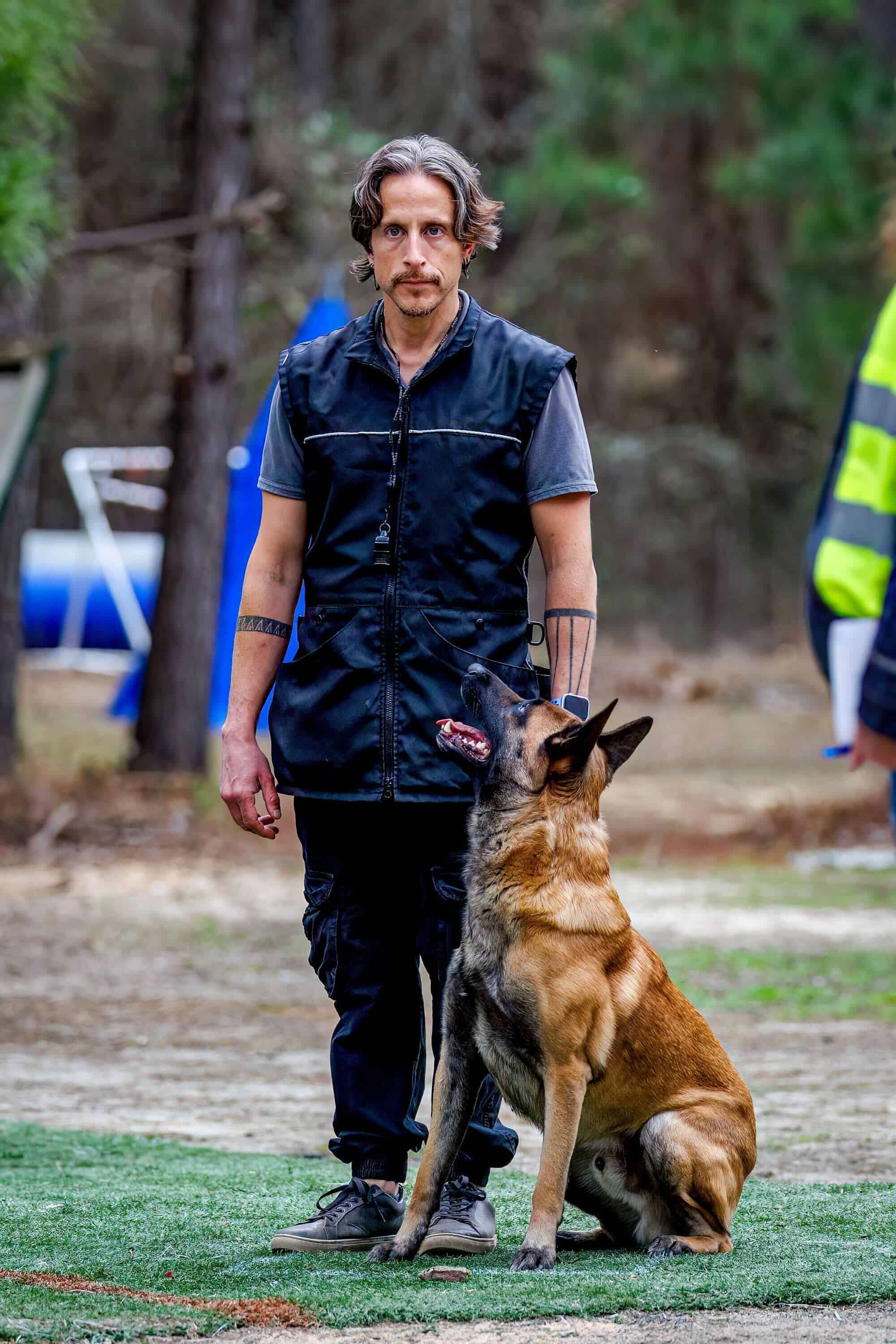
- Doing outings prematurely – Your dog needs to have excellent engagement with you and handler focus before even thinking about doing outings. Ideally, it’s good to have started building a brick house foundation of basic obedience on a dog so that when you do outings, they’re able to anchor in to their skills with confidence when unusual things happen in the environment at new places.
- Making it too hard for your dog, too quickly. You simply can’t take your dog from a calm and stable home environment, and then immediately expect them to behave in exactly the same way in a busy downtown area with hundreds of people, new sights and smells, etc.. Start with the ‘easier’ distractions first (a new place is fine, as long as it doesn’t have an overwhelming number of people), and then build up to the more difficult ones.
- Overwhelming your dog. It is best to only introduce one new distraction in each training session. This is because your dog is going to find it a challenge with just that one new thing to deal with – if you add four or five at once, they will become overwhelmed and the learning opportunities will be limited.
- Not rewarding appropriately. Anytime you train at a new place you need to increase your reward and if necessary lower your criteria. If your dog manages to perform around distractions, you need to let them know that they’re doing the correct thing by rewarding the behavior at the right time. The reward also needs to be sufficient to match the complexity of the distractions they are working around. Rewarding too much, too little, or at the wrong time can fail to communicate to your dog that they are doing a great job and timing is everything.
- Handler frustration/unrealistic expectations. As we said, it isn’t a straight path – so set your expectations accordingly. If you become frustrated or annoyed with your dog not making progress as quickly as you had anticipated, it is not going to have a positive effect on their training. If your dog is unstable in a stationary position when you toss a plastic water bottle, it’s unreasonable to think that they’ll do well when someone is running a leaf blower. It is so important to take your time if your dog is struggling with something and break it down into micro-wins for the dog; smaller successive approximations until they reach the goal. Distractions are difficult and it will take time for your dog to make real progress.
How a professional dog trainer can help with distractions
As we explained earlier in this article, distractions have to be introduced gradually so as not to overwhelm your dog. It can be difficult to strike the right balance and know if the pace is too much, or conversely, if you’re not challenging your dog enough. A professional dog trainer can help you because they have the experience to set up scenarios or stage outings that will enable your dog to make progress – without overwhelming them. If you’re looking to work on distractions with your dog and need assistance, reach out to us at info@k9evolutionsdogtraining.com or call (612) 227-7019.